Otherize the Oligarchs
Redirecting anger upwards

Lately, I’ve been struck by the insufficiency of being right. In the case of my wife’s debilitating fears, being right about the illusory nature of those fears does absolutely nothing to loosen their hold on her. Similarly, in the field of politics, being right is woefully insufficient, unless you are preaching to the choir.
You also have to be effective, you have to win elections, and you can’t win elections or persuade people towards your point of view if you can’t first convince them that you understand theirs, valid or not.
Democrats are often criticized for either not knowing how or not being willing to play hardball. Their well-intentioned policies to protect the vulnerable are inevitably cast in a frame in which the beneficiaries are “otherized” as lazy, conniving or otherwise undeserving. Democrats consistently fail to recognize that framing matters more than content, particularly for the majority of voters who don’t pay much attention to politics.
A policy which has overwhelming popular support such as asking billionaires to pay their fair share in taxes is framed by the opposition as yet another attempt at socialism and the first step towards confiscatory tax policy aimed at the middle class. And oh by the way, this idea is brought to you by the same people who want your daughter to compete against transgender biological males in sports and are trying to slip gender discussions into grade school classrooms. The framing matters more than the content.
But what does it mean for Democrats to play hardball? Do we need to engage in the same demonization that is at the core of MAGA politics? In a nutshell, yes we do, we just need to choose the right demons, not the ones with their hands out at the end of the line, but the ones with their hands in your pockets at the front.
Playing hardball means recognizing that the animating power of anger and grievance isn’t inherently evil, it’s simply a political force that we either harness or deflect. By contrast, taking the high road assumes that moral clarity is enough, that being right will translate into being effective because the public is paying attention and is basically decent, an assumption which recent elections have proven demonstrably false.
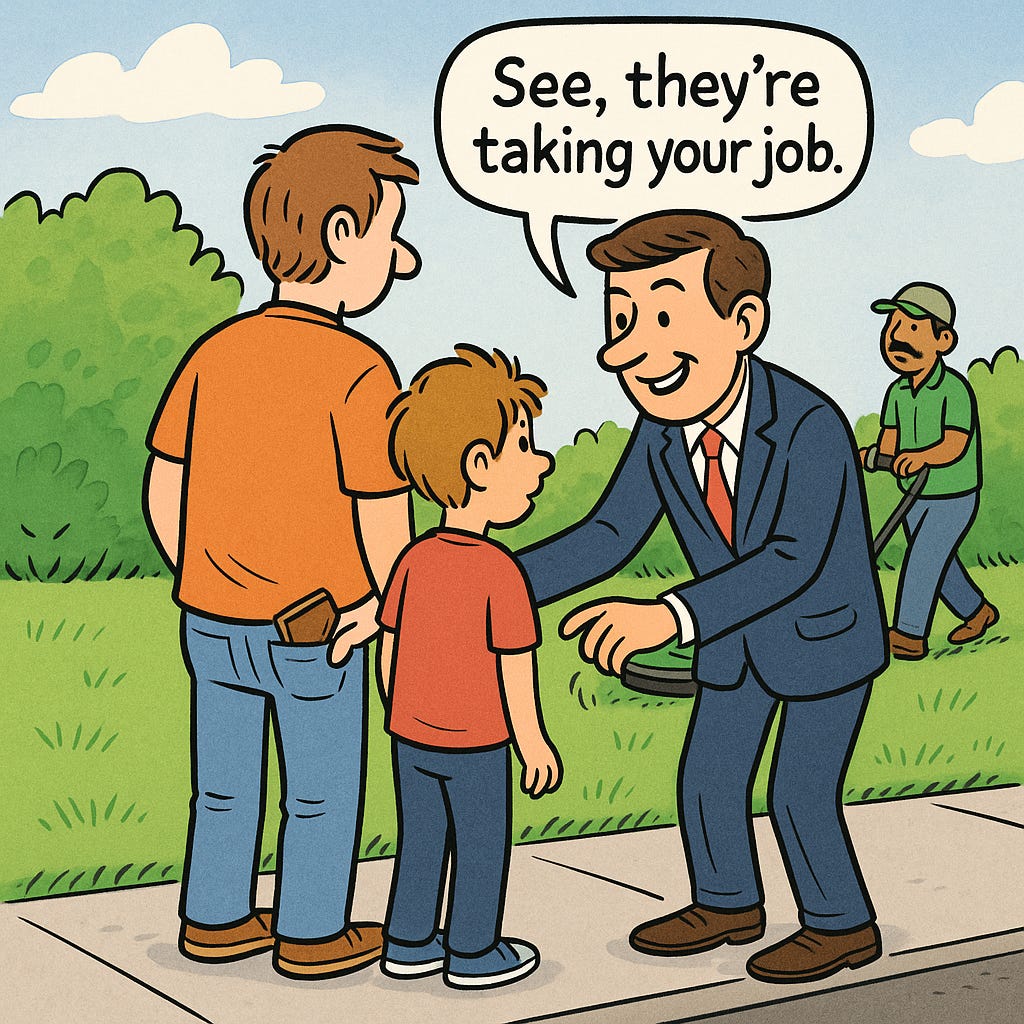
To return to the issue of billionaires paying their fair share, the mistake is to cast this as a moral issue, an issue of fairness rather than what it is: theft. They aren’t just cheating. They are stealing from you, and they are using your money to finance the heist. Referring to them as ”they” is important. If they can otherize the vulnerable, we can otherize them back. And we can call the corrupt redistribution of wealth upwards, financed on the backs of the poor for the benefit of those who need it least what it is: theft.
We already know who they are. They are the ones pushing for tax cuts they don’t need financed by ruinous debt that will ultimately be paid back in the form of price inflation by those least able to afford it. They are the ones coopting the public square to spread disinformation to cover their tracks. And, contrary to the fictions they spread, they are the ones who think they are smarter than the rest of us and deserve to rule. Democracy is just another set of rules limiting their power.
Democrats need to redirect the frustration of those who have been ignored and marginalized upwards towards its actual source. We need to paint that source in bright colors, as bright as the skin color of the immigrants they demonize to distract us. We need to otherize the oligarchs.
One cautionary note. Anger is a blunt instrument that can be difficult to redirect without collateral damage. A good therapist might not recommend the redirection of anger or fear as a frontline treatment because of its inherent unpredictability.
I would argue that moral clarity is not persuasive on its own, particularly when the opposition controls or is attempting to control all sources of information that might use that clarity to persuade.
It’s also easy to snare potential allies when you cast your net wide in search of enemies. Those who tacitly enabled injustice and corruption without anticipating its scale may now be the victims of it, and are potentially part of a coalition that is needed to fight back. Their anger, the anger of the betrayed, not simply the outraged, is particularly important in changing minds and hearts.
There is already ample evidence of that betrayal in action. Farmer’s labor pools decimated by indiscriminately deporting workers, and the gall to then warn the rest of us to brace for higher food prices. Food shortages for up to 40 million people who depend on food stamps. Foreign agricultural markets destroyed by tariffs.
The victims in many cases have enabled the perpetrators. But, rather than shame them for bringing it on themselves, we need to recognize their suffering and redirect their rage.
In caring for a spouse with delusional fears as I do, it starts with recognition, recognizing fear and suffering without validating the belief underlying it. Easier said than done, and in politics, that recognition can be painful. It can feel like a betrayal of identity, but that tinge of discomfort, of self-negation, is a sign that you are constrained by tribal affiliation.
Politics is the art of expanding the coalition, and you can’t expand a coalition by dismissing the concerns of those outside of it. Persuasion doesn’t follow from correctness, it’s not about being right, it’s about recognizing and redirecting emotional energy. It’s the same task for both politicians and caregivers.